

Central Kalahari Game Reserve
Ken and I said farewell to Karen then begun our big adventure into the Central Kalahari Game Reserve (CKGR), one of the largest game reserves on the planet and one of the most remote areas we would enter on this trip.
We could have stayed in Deception Valley for the rest of our lives, filling up one field journal after another; its mysteries are for us an endless fascination.
- Mark and Delia Owens, Cry of the Kalahari
We stayed over at Camelthorn Camp near Makgadikgadi Pan and close to the town of Rakops in order to situate ourselves close to a final resupply and the northeastern park entrance. Camelthorn was nice! Part of a breed of higher-end private camping options that offer nice amenities on top of a place to park your vehicle and sleep. In this case it was nice ablutions and a hide situated over the Boteti River looking into the adjacent national park. The Boteti is a partial diversion of the Thamalakane River (which passes through Maun) that created a dam to support the diamond mining in the area.
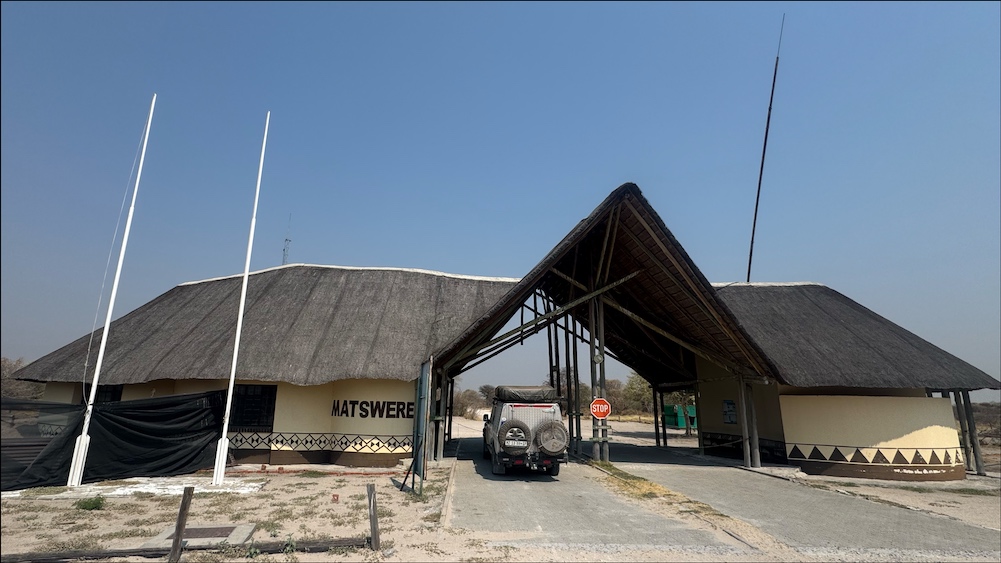 Arrival at CKGR Matswere Gate
Right off the highway we found the sign marking the traversal road to get to the park, about a 2 hour drive over sandy washboard road. We were warned multiple times to bring plenty of extra diesel and water to account for contingencies and just normal operations in the park. We carried 8 extra 20 liter jerry cans.
You could tell the folks at Matswere Gate, the busiest entry, don’t see many folks passing through. We had to check in with the park reception to make sure our paperwork was in order, then check in with the Big Foot concession operator which runs two of the four campsites we’d be at. The seemingly random division of camps between Big Foot and the park service itself was odd and raised questions in our heads - who is benefiting from this arrangement? Certainly not the visitors as it makes booking very tedious and our Big Foot sites were mostly worse than those run by the park.
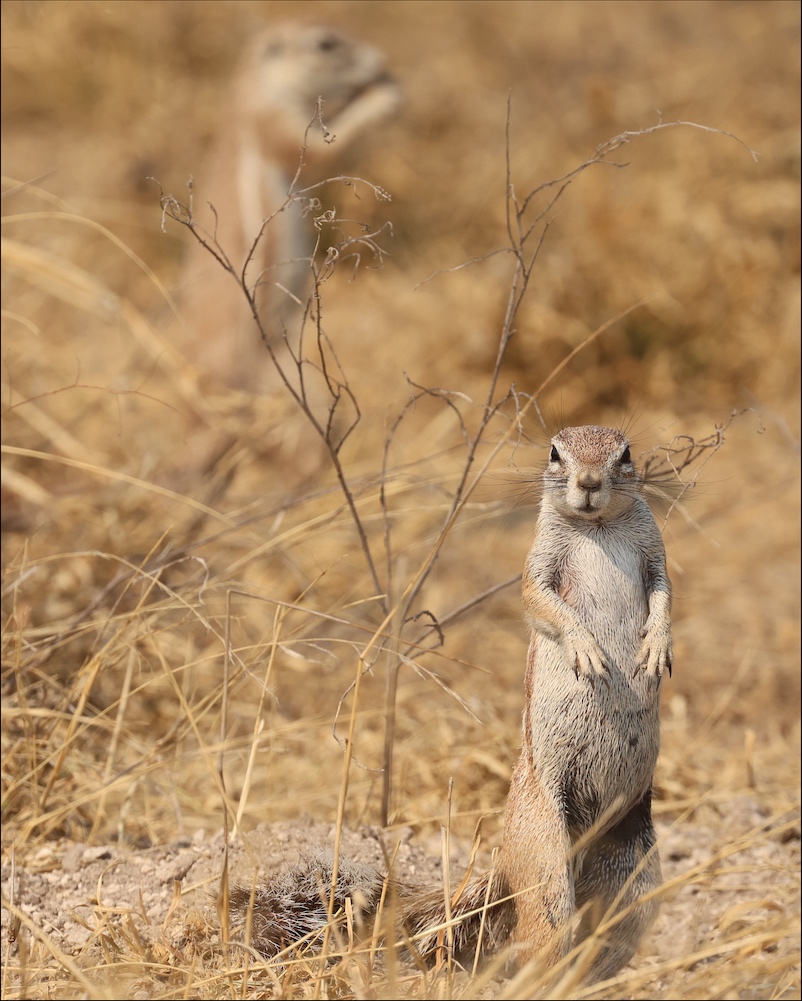 Cape Ground Squirrel
I of course had my target list of new birds to search for in CKGR and we started seeing some on the transit road itself - pale chanting goshawk, yellow canary, and Marico flycatcher - as well as the routine residents that would be omnipresent throughout the rest of our 7 day stay. The Cape ground squirrels don’t get the same attention as meerkats but they are a worthy proxy.
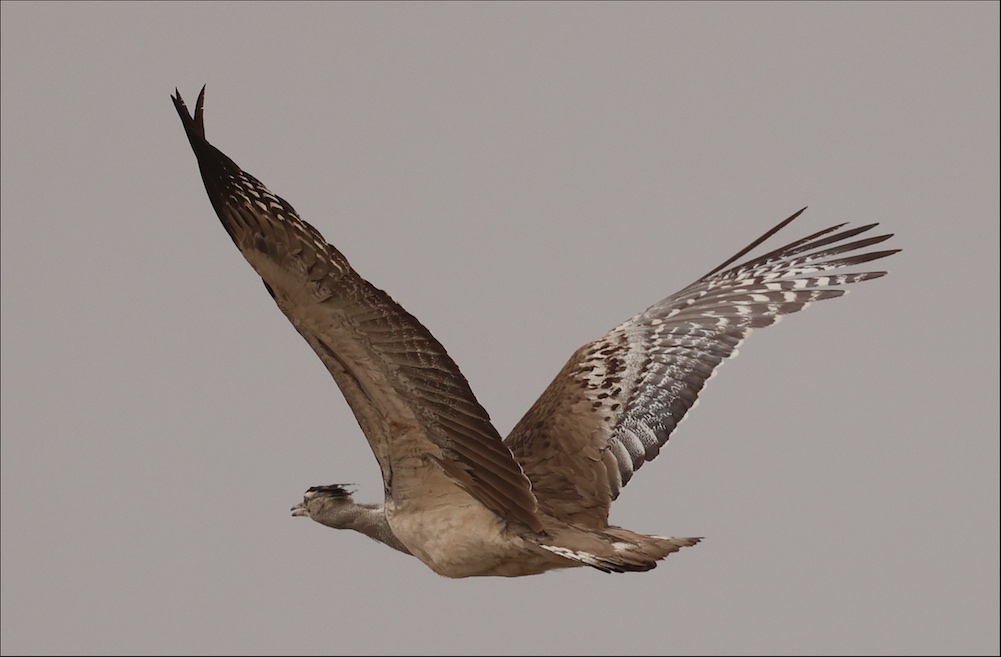 Kori Bustard takes flight
We thought we had seen a lot of Kori bustards on this trip already, but we had no idea what was in store. On the first day driving in to Deception Pan we lost count and I wasn’t maintaining a continuous checklist of birds in eBird. So on the second day we kept deliberate count and tallied 110 of them. This is the national bird of Botswana and appears to be thriving in the CKGR. The Kori bustard is the heaviest flying bird (not the biggest wingspan) and we rarely see them in flight.
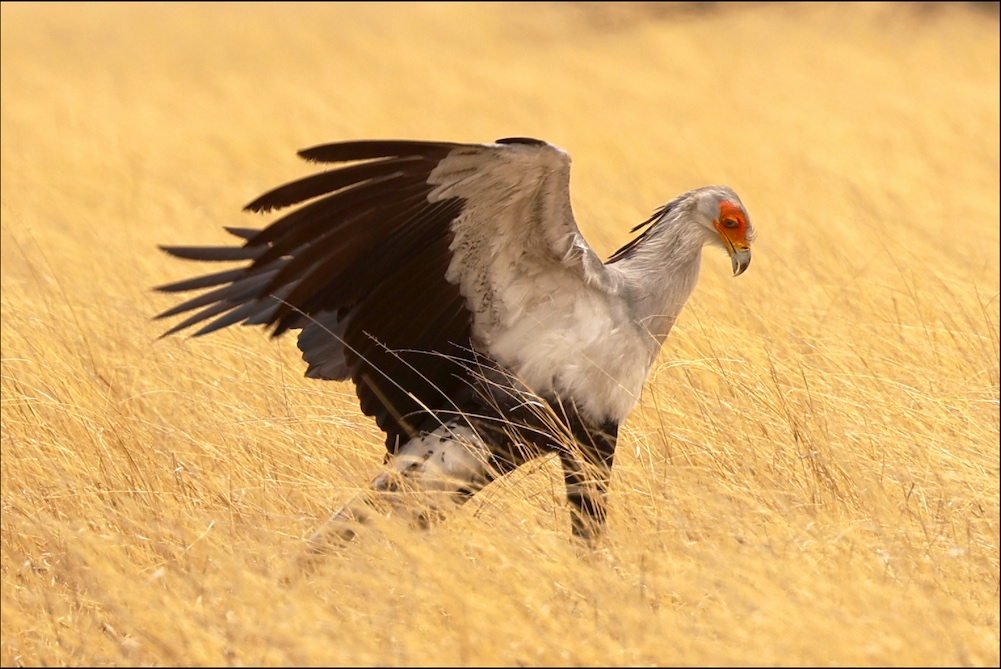 Secretarybird hunts
As we’ve moved into desert terrain we were hopeful for more secretarybird sightings and I think we saw at least one each day. We could often parallel the bird’s (sometimes two in tandem) path by driving along and watching it hunt, stamping down on a snake, lizard, or amphibian and sometimes chasing it before snapping it up high to swallow.
The terrain on our arrival day was different than I expected: thick brush with slightly rolling hills and valleys, with few sight-lines to scan the horizon. It wasn’t until we reached Deception Valley (and pan) that things started to open up for us.
Our camp the first two nights was near Deception, staying at Kori campsite 2, though we were supposed to be at Deception 4. Ken and I discussed and believe that my original recommended itinerary was Kori for the start but we were only able to book Deception campground. It didn’t matter - there was nobody else at any of the campsites in the area.
The full day between camping nights in Deception was spent on a long 100 mile drive out to Passarge Valley. The drive was rough and taxing, but once we hit the valley the payoff was great as we started to uncover the magic of CKGR: spans of connected pan basins filled with beautiful blonde grass. These pans are where we would find the big herds of springbok and gemsbok.
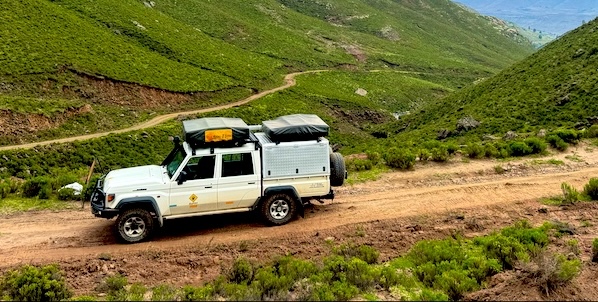
Night two in Deception was rough as the winds kicked up to steady 20-25 and gusting over 40. There was a small threat of rain so we put the tarps on our rooftop tents, and man-oh-man do they make a lot of noise in the high winds. They also form a parachute-like wind capture scheme that makes you feel like the tent is going to blow off the Land Cruiser. Ken and I both felt the fold-out sandwich board of our platform lift up at times during the night.
The winds stayed up the next day sustained at 20+ mph, which put a damper on our game viewing. Really nothing in Deception Pan except for some springbok hiding behind trees and bushes and… Kori bustards. Our path took us out Deception Valley and across the bushy hills to make our way to Piper Pan. This is a long drive and we had a camp stop planned to break up the drive at Letiahau.
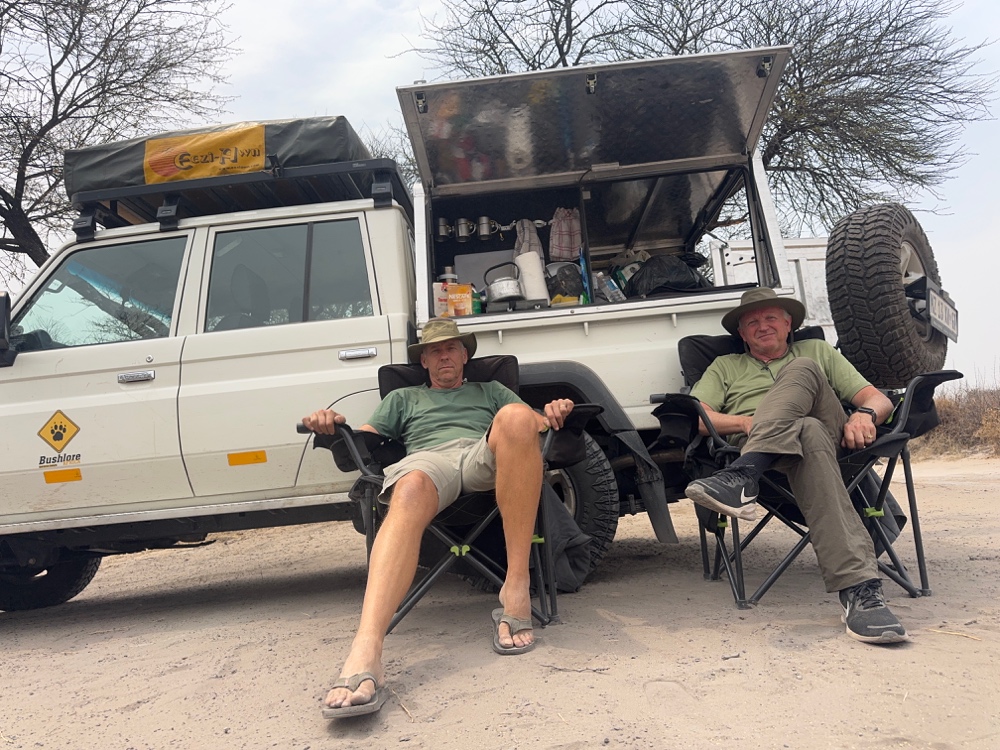 Sad times at Letiahau Camp
This is one of the Big Foot concession camps and hardly qualifies for that designation: no view, a sad water hole 5-10k away, and not even a pit toilet. We sat there mid-day bracing ourselves from the wind and sun and asked outselves: what the hell are we doing here? We hadn’t seen another car in over two days and decided to push on to Piper Pan and take our chances at finding a vacant campsite there.
Another note for itinerary planners: if I was planning an east to west traverse again, I would book Deception Pan, then Passarge, the Piper Pan. Passarge was beautiful and we wish we had more time to explore there.
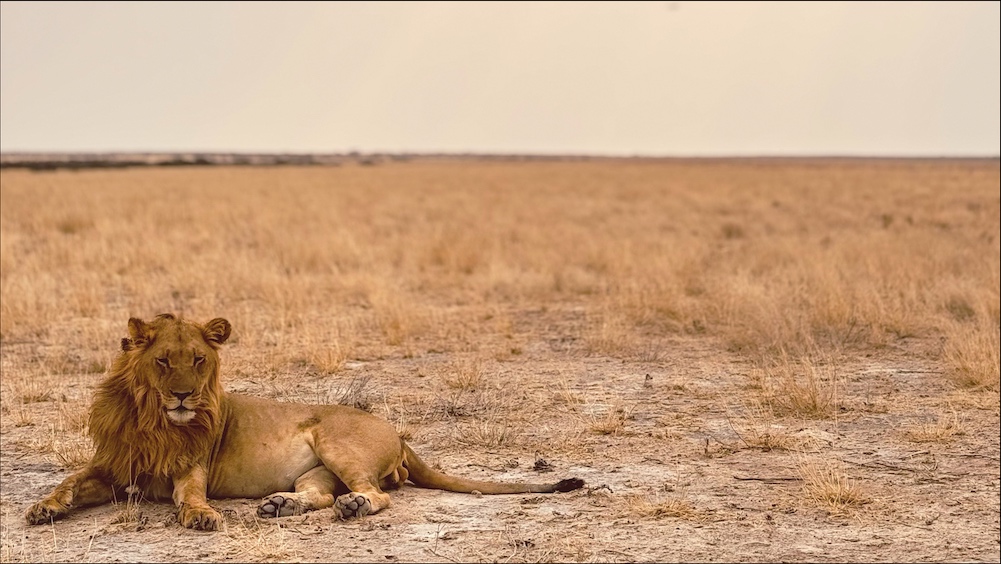 Male lion in Piper Pan
The payoff when we hit the pan was immediate - a lion pride hanging out by the water hole in the middle pan of the three-pan arrangement at Piper. And in the hills above to the south three bull African bush elephants making their way tromp-tromping through the trees to get to the water hole. We had high hopes for Piper with three nights ahead of us there.
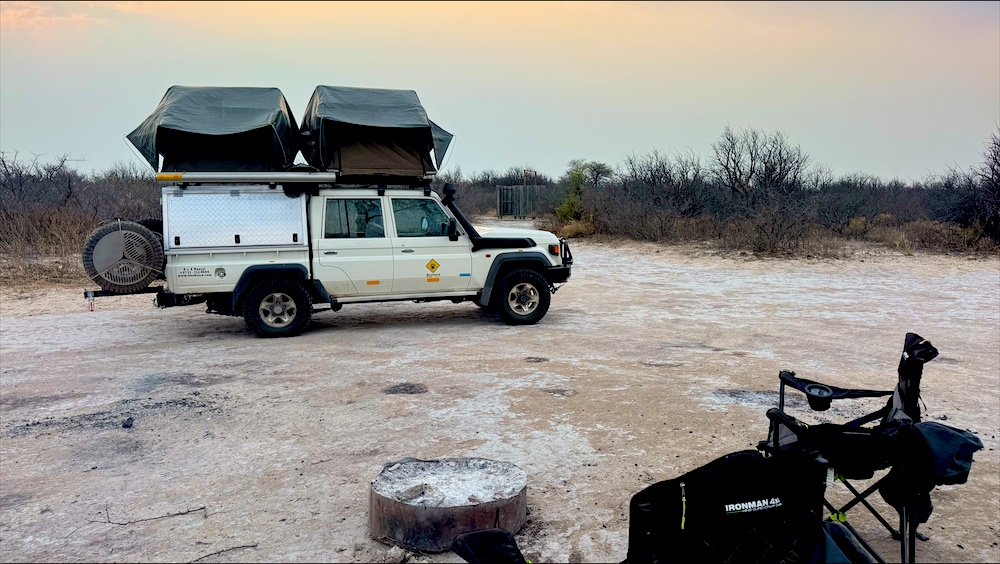 Camp at Piper Pan
We claimed Piper 1 as our camp the first night as it is closer to the pan and it was empty. So was Piper 2. We thought Piper 2 was our designated camp the two nights after this first night, but my record-keeping was wrong again and we were supposed to be in this camp all along.
Starlink was relied upon not just for my schoolwork but also for weather forecasting and we had some real concerns: as much as 2” of rain might fall over the next 48 hours. A typical September (still dry season, which is most of the winter months) gets about 0.1 to 0.2 inches of rain. Also concerning was the continued high wind forecast.
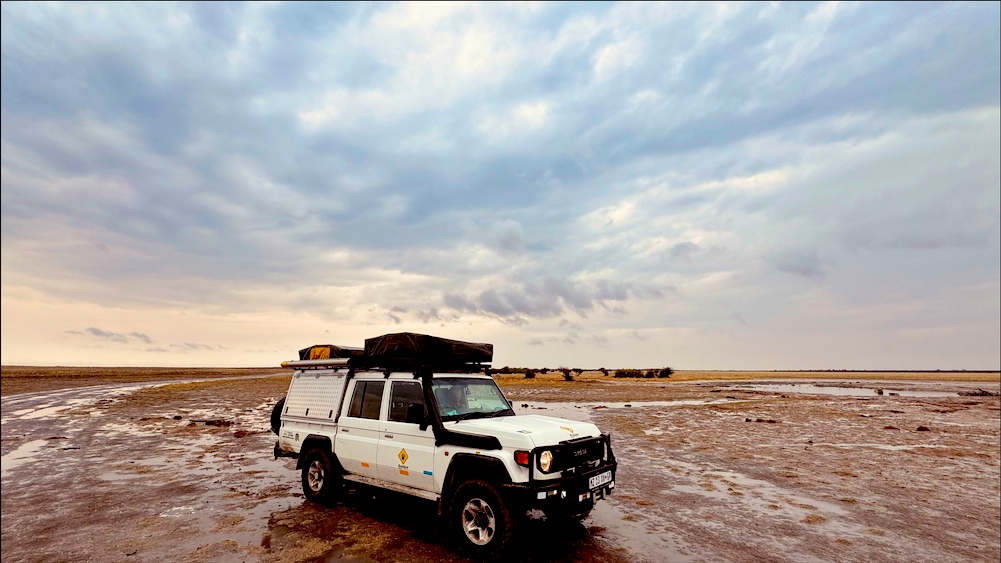 Piper Pan after two nights of 15-20mm of rain
Our first night in Piper was rougher than the windy night prior: all the wind action we had before, but now with close-by lightning and thunder and heavy rains. No deep sleep was had that night and Ken and I both took the opportunity to record some video from our tents as we couldn’t believe the noise and the wind and the rain and that the tents were still staying intact.
We believe close to a half inch of rain fell that first night and the next morning, and the landscape around the pans changed with much standing water.
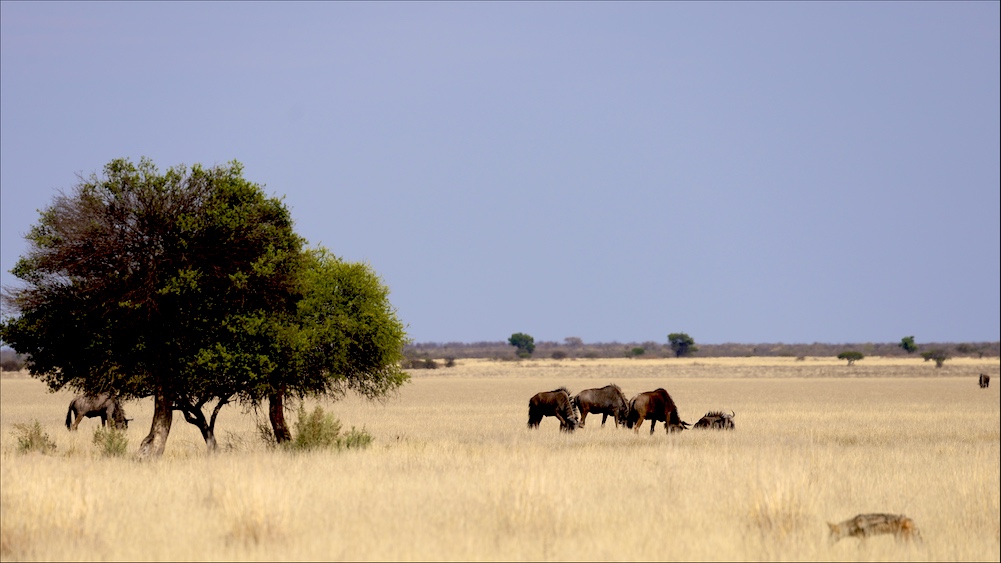 Wildebeest in Piper Pan with black-backed jackal
The winds stayed high all day, but in the aftermath of the rain we saw the landscape transform and the wildlife emerge. Wildebeest, springbok, and gemsbok herds were everywhere. We would routinely see black-backed jackals, sometimes in groups of two or three, darting around grasses likely finding some new emerging food that is a delicacy to them (frogs?).
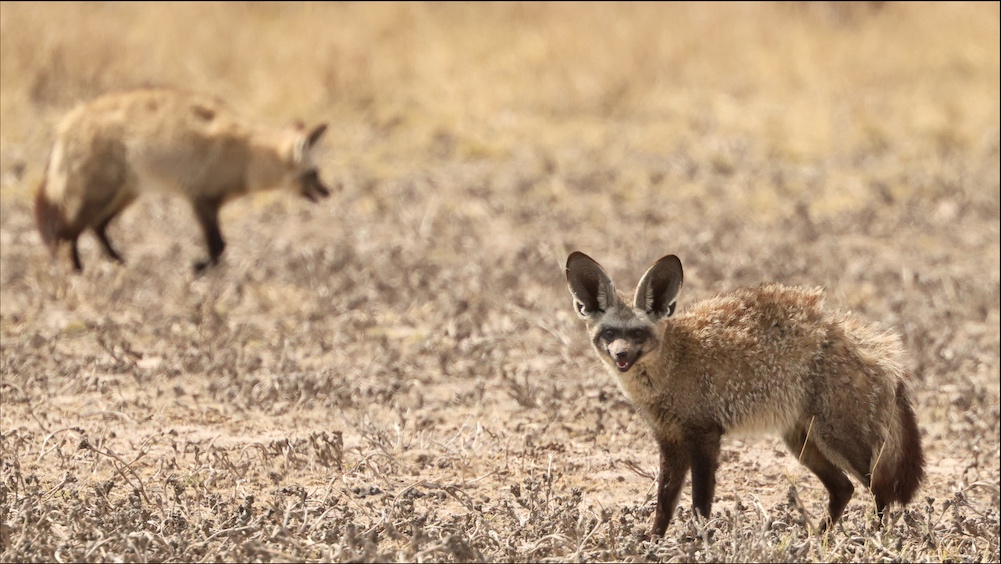 Bat-eared Foxes
And the bat-eared foxes were everywhere! I’ve struggled to get quality photos of these elusive critters but they gave me ample opportunities in Piper Pan.
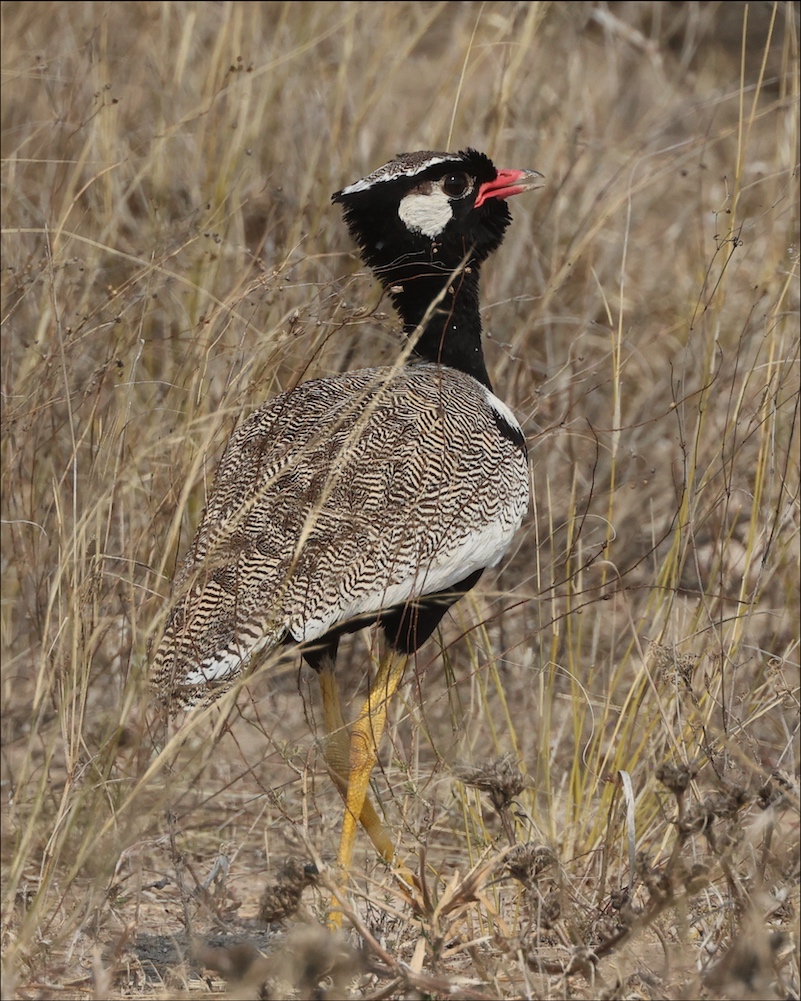 White-quilled Bustard
There are three nodes to the Piper Pan depression and we spent the day making figure eights, circling the entire pan twice and never tiring of our viewings. There’s another bustard to mention: the white-quilled bustard (aka the northern black korhaan) were also ubiquitous and they are into mating season. The males (one is pictured above) fly straight up in the air, stall, and descend back down under control as a display of prowess to hopefully willing females. They also puff out their feathers making them look cartoonish.
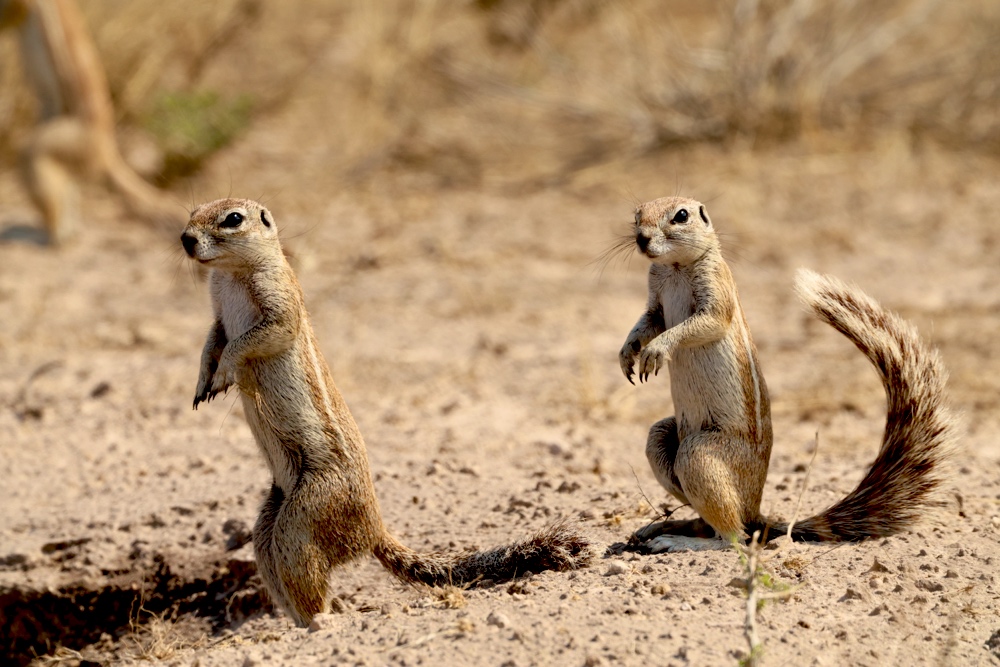 South African Ground Squirrel
Everywhere around the pan we found South African ground squirrel colonies and the rain had them out and more active than usual.
The second night in Piper we moved to what we thought was our actual campsite and endured another night of the same, maybe even more rain this time. Exhausted from lack of sleep we endured in our double-lap of the pan and finally encountered another vehicle, our first one in over three days. It was a Zimbabwean couple that we chatted with for quite a while, discovering that they in fact were booked for Piper Pan 2 that night, moving us back to site 1 which was mostly underwater at this point.
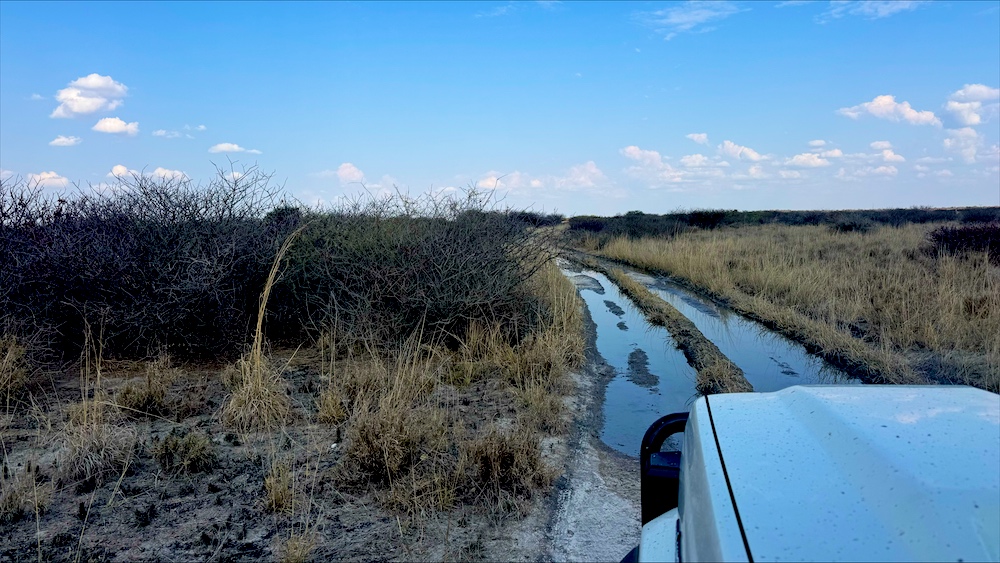 Navigating some challenging washed-out roads
And so were some of the roads, especially the joining roads between the east-most pan and the center one with the water hole. In our risk assessment before the trip Ken and I called out CKGR with just one vehicle as being a key risk factor; recovery is much more difficult when you are on your own and when there are no trees of big rocks for the winch to work off. We got mired in the mud on one of these transition roads and we grew concerned that it was going to be a muddy slog to try to get the vehicle free, but Ken was able to rock us to freedom. We avoided that transition for the rest of the trip and advised the other couple to do the same.
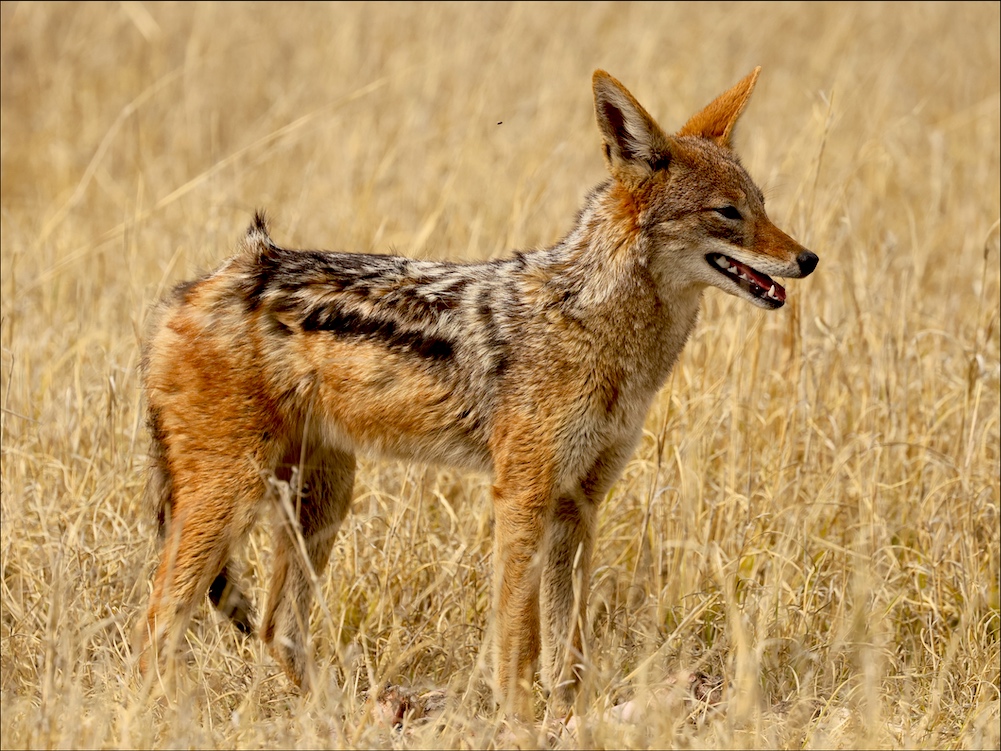 Black-backed Jackal in the pan
The jackals and bat-eared foxes remained just as active on our final full day in Piper, but we never saw more cats or elephant. There was a kill somewhere off the road based on the vulture activity but we couldn’t get close enough to see.
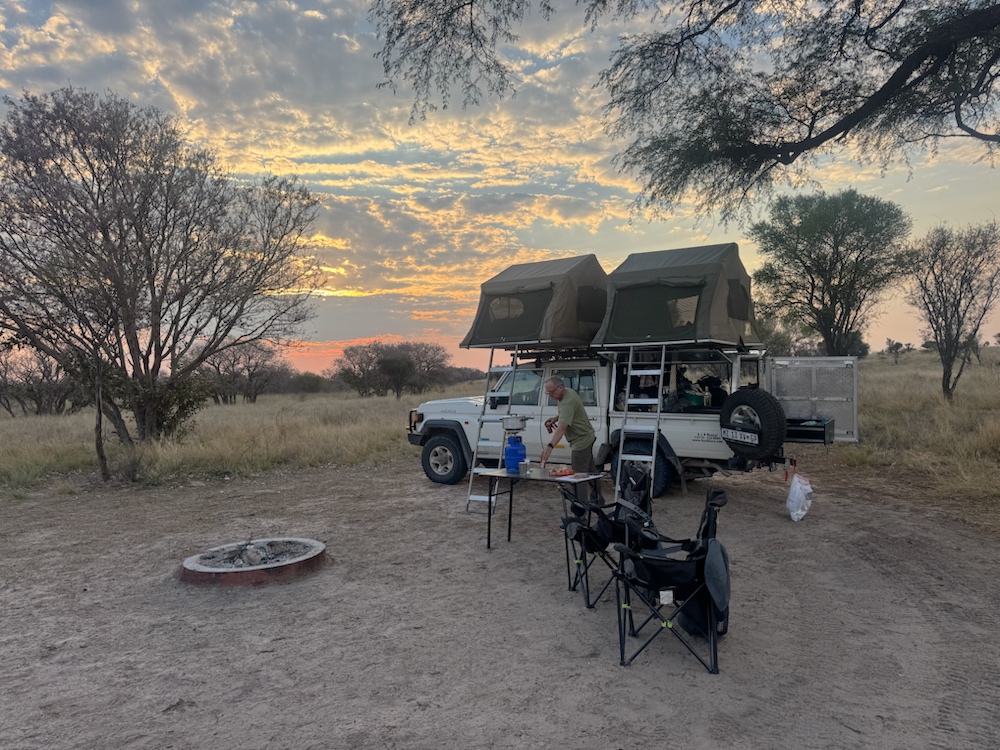 Camp at Xade
We left the beauty of Piper Pan for some more dreary bushy driving dotted by some nice small grassy pans, including one where we were able to safely hang outside the vehicle for a late breakfast. Our final came would be at Xade, the southwestern most gate but still well within the CKGR boundary. This camping area was another disappointment: there are two or three campsites near the ablutions area but to us appeared to be not used at all: they were overgrown and not maintained. Xade 1, our camp, is away from the ablutions and gate by about 2km and has no facilities other than a fire ring. No pit toilet. There is also no guidance on human waste and no surprise we found patches of toilet paper scattered above ground in several areas.
To add more fun, elephants recently destroyed the water system at the ablutions area so if you want to use those toilets you have to fill the tank manually. They recently build a new electric fence around just the Xade gate but the fence doesn’t surround the ablutions area or the staff camp. The ranger we chatted with shared his commentary: he had told the project manager that the fence should also surround the ablutions area. They didn’t want to spend the money. So now they get to spend more money rebuilding the ablution block.
Wildflife was different in this area as we stopped seeing springbok and gemsbok and started seeing kudu and red hartebeest. And a big family of ostrich with two different young broods of chicks!
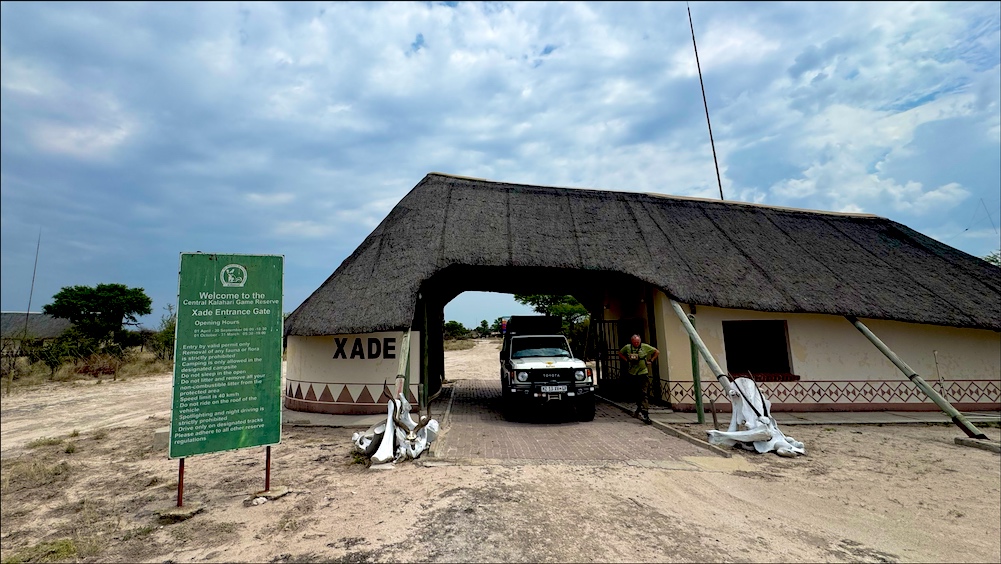 Xade gate at CKGR
After six nights in CKGR we exited through the Xade gate and made our way to Ghanzi. It was still about 2 hours of driving on rough dirt and gravel before we hit the park boundary. We used two of our jerry cans to get enough fuel to get us to our Ghanzi resupply.
Stuff I wish I’d been able to see in CKGR: brown hyenas, what remnants remain of the Owens camp (Cry of the Kalahari), Deception Valley without high winds, and a cheetah.
This reserve wouldn’t have been a great fit for the bigger group. Our interest in birds got us through an entire day of seeing minimal game mammals, and the toilet situation would a non-starter for some folks. Add to that some long long drives through bushy forest without views (elephants can be 10 meters away and you won’t see them) and you have a park that isn’t right for everyone.