

Gonarezhou National Park, Zimbabwe
Your road is bad; pave it. Better yet, build a paved road to every corner of the park; better yet, pave the whole damned place so any damn fool can drive anything anywhere—is this a democracy or ain’t it?
- Edward Abbey, Desert Solitaire: A Season in the Wilderness
After a challenging border crossing into Zimbabwe, we knew we still had a long drive ahead of us as well as a sunset hitting about 6pm. Three hours to make the Gonarezhou entrance gate that might be 5 or even 6-7 hours away. Fortunately Ken had a WhatsApp chat already established with a staff member in the park because of some double-booking issues that happened a while back, and we were able to communicate our delay and arrange for a late arrival and adjust our campsite to a different spot. Just in case I had bookmarked a lodge hotel about 90 minutes from Beitbridge (possibly the only option for us if we couldn’t get to the park) but given the confirmation from the staffer we decided to go for it and get into the park. We were surprised by this exception as night driving is explicitly forbidden in the park.
Navigation to our target gate, Boli, was going to be a challenge. The A4 highway that runs from Beitbridge all the way to Harare turns away from the park about 200 km from Beitbridge so you either need to cut over on a side road or go all the way up to the A10 and take it to Chiredzi before dropping down into the north entrance of the park by Chipinda Pools. The Chiredzi route didn’t make sense for us because our adventure was starting at the southwest end of the park at Rossi Pools.
The Boli gate isn’t on any maps we had - Google, Gaia, etc. It is on the official park map PDF, but is given without much context. Still, we could find the village of Boli on the map and I could see a road that went directly south from there along the park boundary. So we set our nav to take us to Boli village and would find our way in from there.
 Entering the Nuanetsi Conservancy
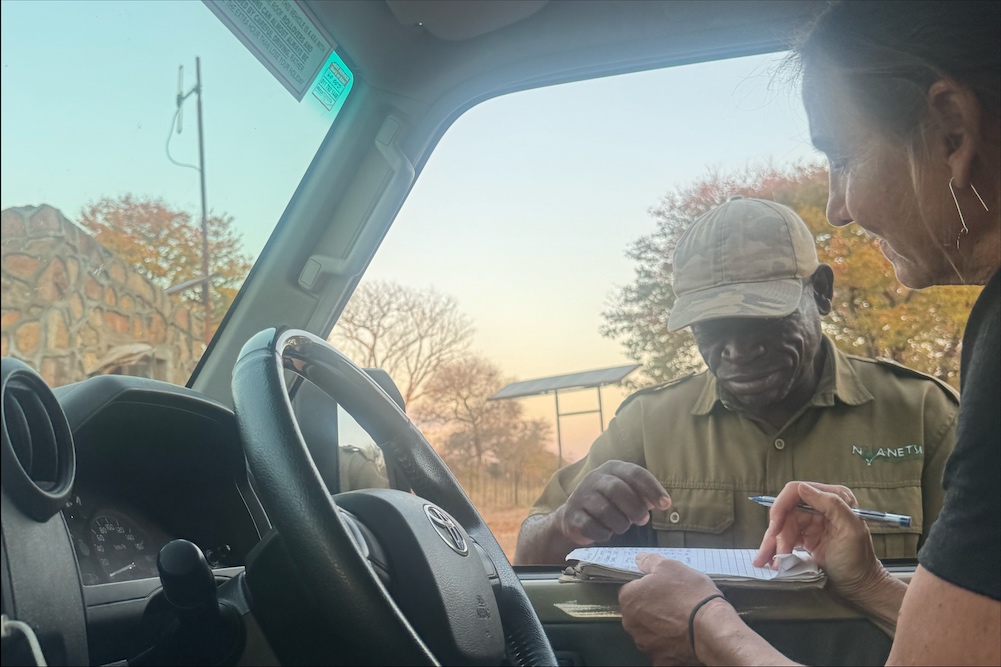
About 32 km past the last-chance lodging at the Lion and Elephant Lodge we turned off onto a dirt road that would begin our cut-off to Boli. Almost immediately I was concerned that this was a bad route as we hit a security gate. The guard was kind (every single local we interacted with in Zimbabwe was nice to us) and just took down our plate numbers and confirmed that this was a route into Gonarezhou (maybe not the route, but a way). This would be the first of three gates we would pass through as wandered through the Nuanetsi Conservancy, which on later research we learned is likely a big and dangerous game hunting reserve. We hit the first gate while still daylight at about 5:30pm.
We had doubts all along the way as we rambled on this road, which included a river crossing on a dam, but on reflection (and seeing other roads) this might have been the fastest way into Boli and the subsequent gate. We finally found the Boli gate at 8:15 and made our way down to Mabalauta Rest Camp, about an hour south from the gate.
 Camp at Mabalauta
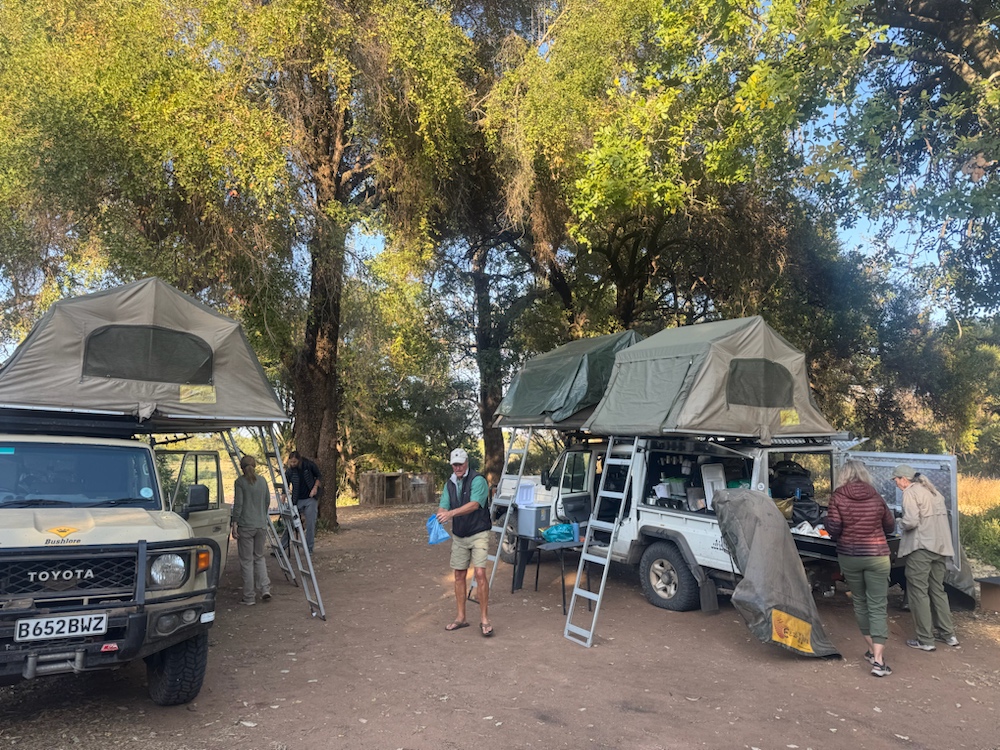
The camp was unoccupied and outstanding, sitting on a bank over the river and having excellent ablutions. After a long day of driving we took a well-deserved slow-start morning to re-organize, observe the local bird-life, and make a plan for the day. We had to wait for the reception office to open nearby before departing so that we could formally check in. At check-in we got two physical maps and made our plan: continue further south to Rossi Pools (where we were originally supposed to camp the night before) then work north on some 4x4 roads to our next camp.
 Looking out over Rossi Pools
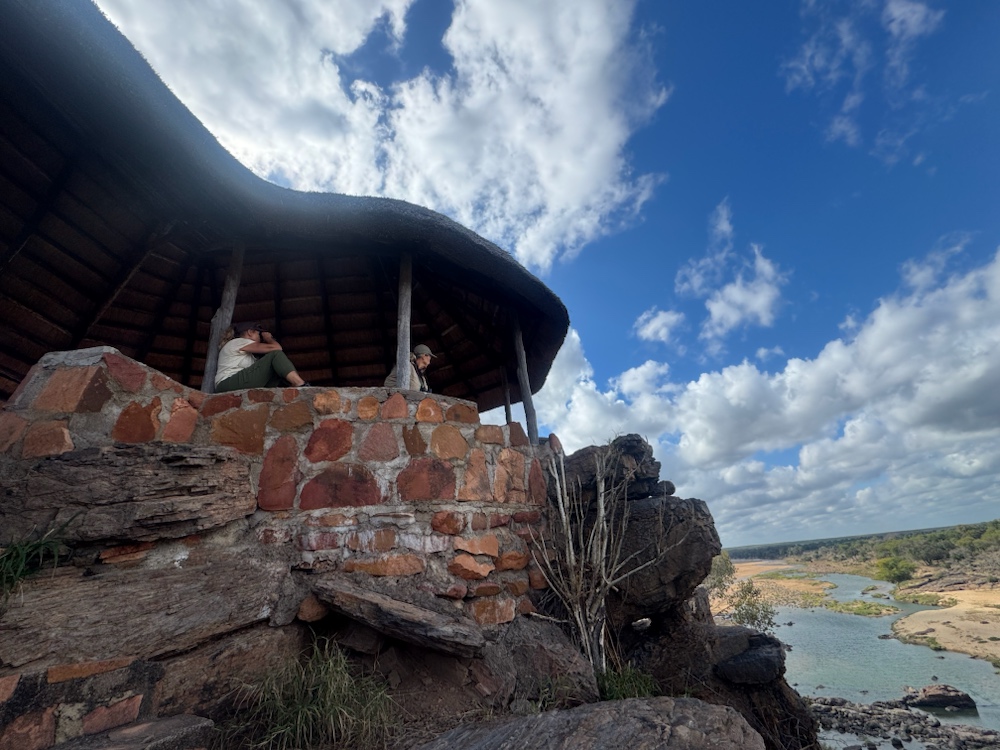
Rossi Pools was spectacular: a wilderness camp with a pit toilet and a large shelter sitting over the cliffs looking down on the river. We hung out here for an hour, having breakfast and observing the wildlife: crocodiles, plenty of birds, lizards, and antelope across the river including a pair of klipspringer.
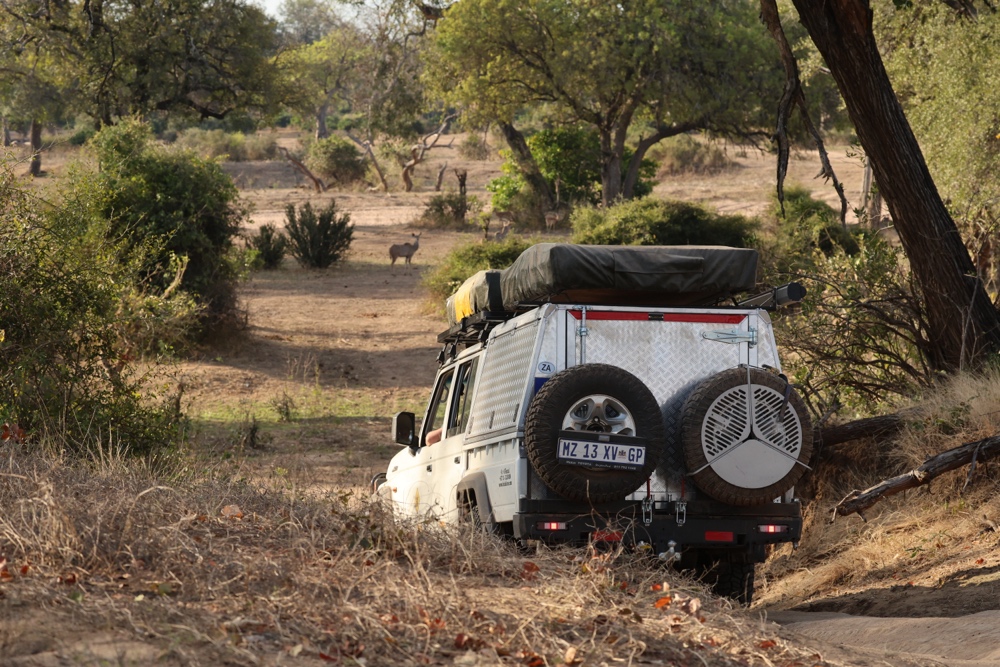 Working our way north from Rossi to the Runde
Another long driving day was ahead of us as we traversed about 2/3 of the park going south to north through the interior. We took an explicitly designated 4x4 path that wasn’t difficult for us, but it is worth mentioning right now: none of the roads in this park are to be taken lightly. The only tar road we found was a slab near the refueling spot near Chipinda. And that’s just the roads – we’ll talk about the river fording shortly.
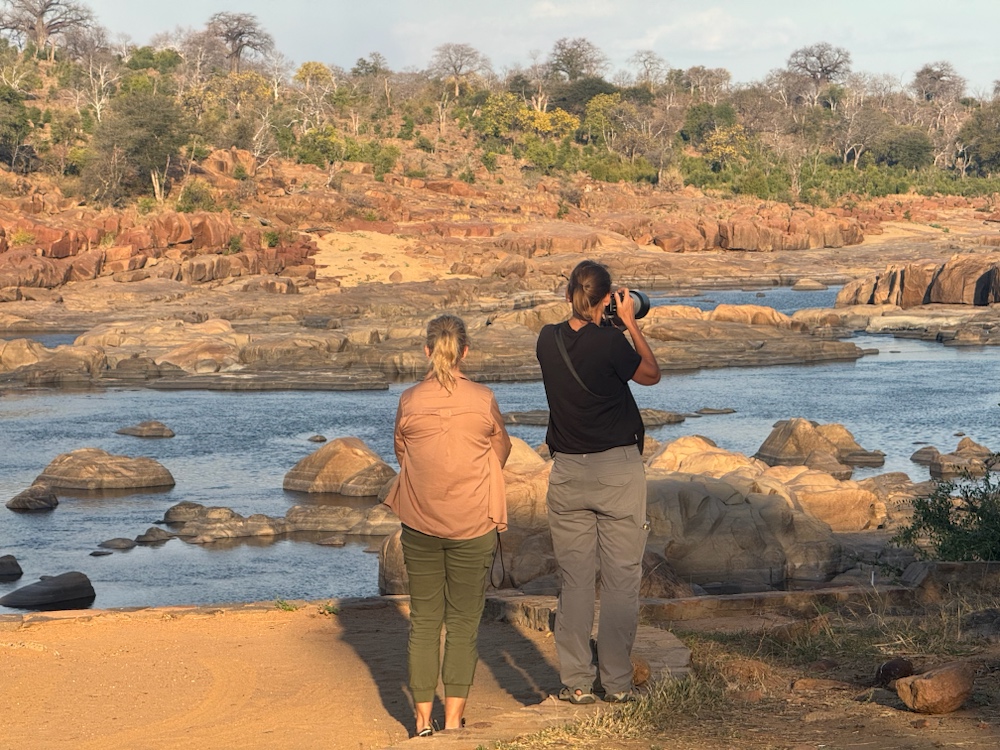 Karen and Jeanne looking at Runde from Chinguli camp
We were all excited to have three consecutive nights at Chinguli Camp, one of the most beautiful places I’ve ever overnighted. The community around us (other overlanders of course) was fun to chat with, and Ken’s friend Wolf and wife Barbara joined us the first night. Ken and Wolf went through the Ecotraining guide certification field training together last fall.
To fully explore the park requires river crossings, and other than a nice causeway bridge just downstream from Chivilila Falls this means fords. Don’t be fooled by the “causeway” label: these are simply marked ford locations, and two of those were closed (without marking - you had to learn this from staff or other visitors) because of high water.
Our two Land Cruisers had zero issues with the fords, but as we returned on the first day after exploring the north side of the Runde River we noticed some fellow campers (they were in an adjacent site and were in Gonarezhou to fish - locals from Chiredzi) struggling with the ford. Two of them were walking across the river, presumably scouting for their vehicles. We would learn after chatting with them that one of their vehicles (a 2WD truck) was stuck in deep sand.
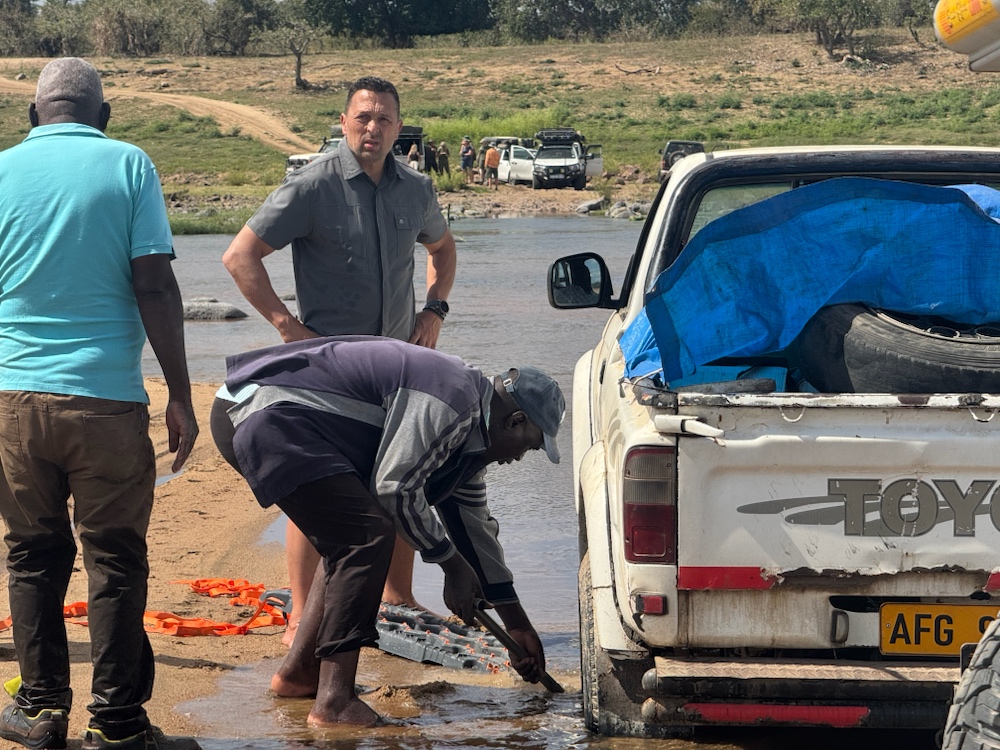 Starting our rescue
Karen, Julie, and I hatched a plan to cross and try to pull the truck out of the river sand to give it a fresh start, then possibly tow it across the river. This was ill-advised as we then became mired in the deep dry sand. This wasn’t a difficult recovery but we needed a plan B. Another group of overlands (mix of South African and UK) folks arrived at this point, and one of the vehicles crossed over to us and we discussed options. One of the gentlemen in this vehicle was very experienced and hatched a plan: we would lay down recovery skids one in staggered fashion as we rolled the truck forward inch by inch to cross the river. So with two skids on a side for the two active wheels, and with all four of the locals pushing their own truck and our expert driving the truck, we started the process of laying the tracks as we went. After 20 minutes or so we worked the vehicle all the way across the river.
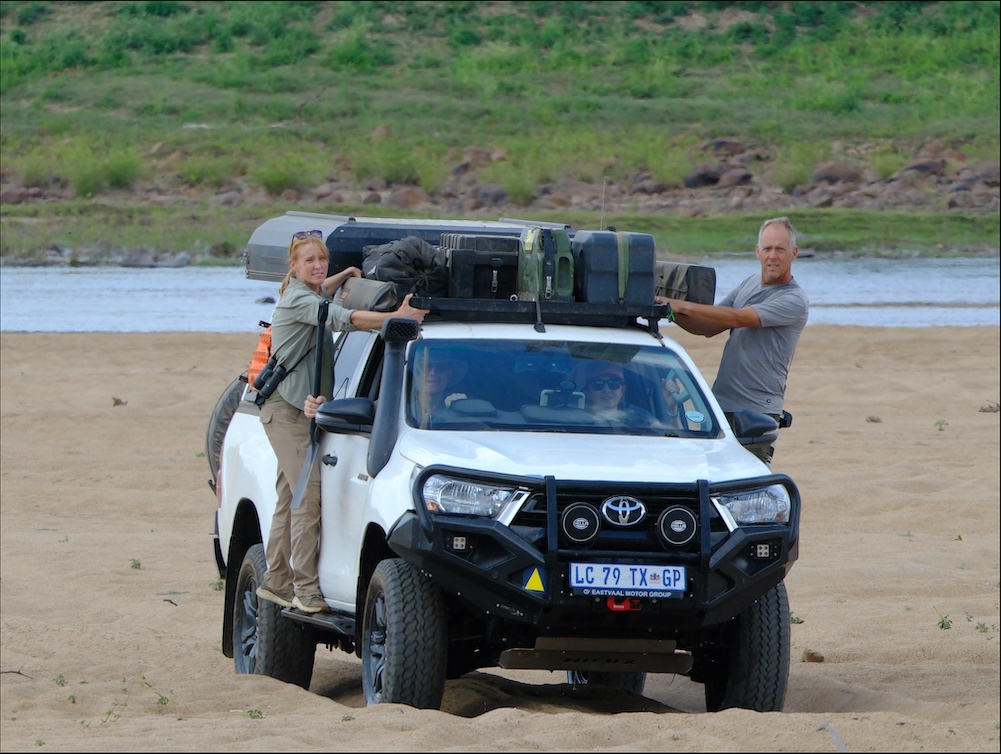 Chris and Julie getting transport back after rescue complete
It was a great team effort and a source of much amusement for the folks waiting on the other side of the river. Julie and I hitched a ride on one of the other vehicles after it forded to rejoin our party.
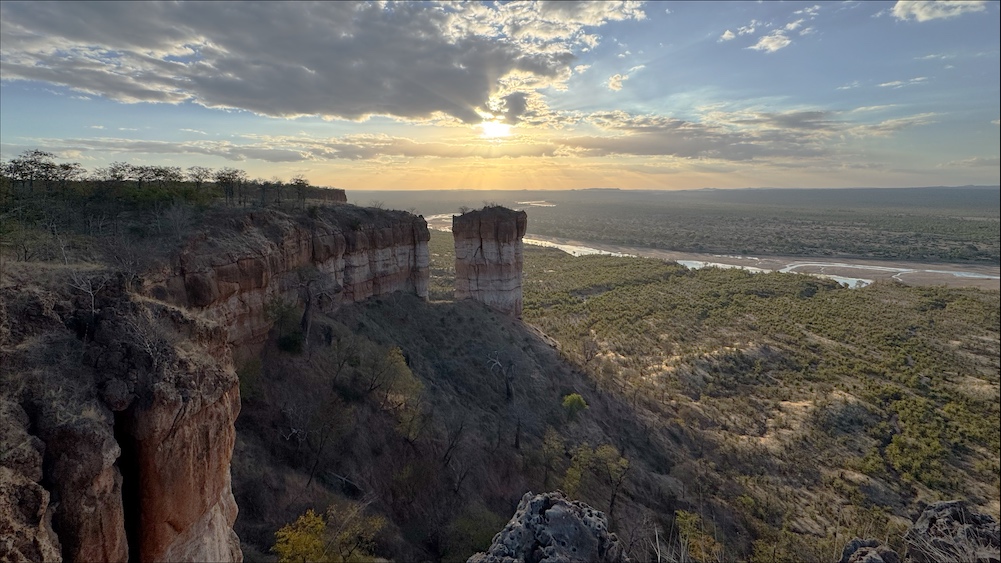 Chilojo cliffs at Gonarezhou
Our evening drive that first day was up to Chilojo cliffs, the most dramatic landscape feature of the park. A great place to watch the coming sunset. Again, not an easy drive to get there (major washboarding) and it was a race to get back to camp by the presumed 6pm deadline.
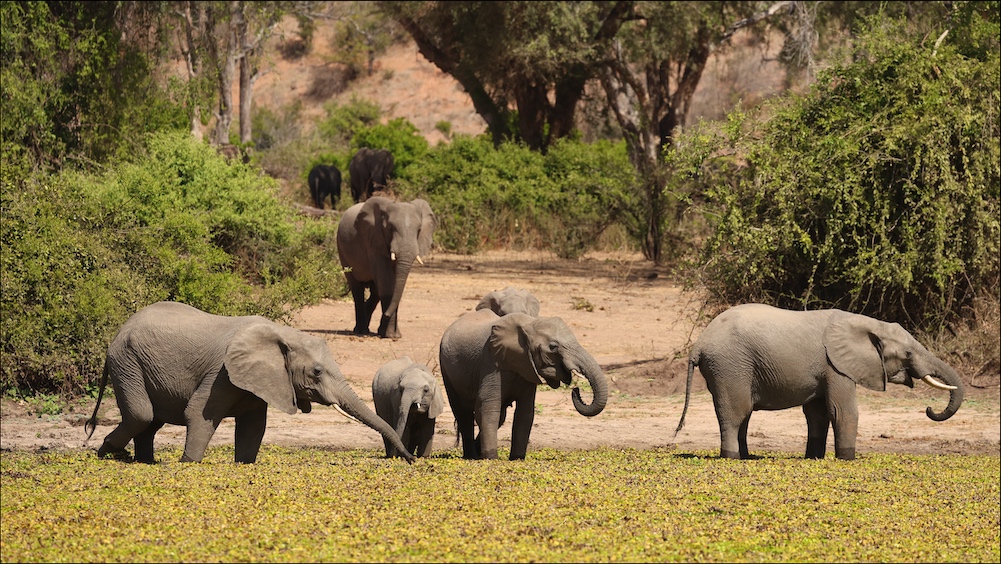 Elephants coming to the pan
On day 2 we did the “big loop”, crossing the same ford to travel along the Runde to the east on the north side of the river. Amazing birds, antelope, mongoose, and more. Sadly for our party no big cats or wild dogs. We crossed the river again at Chitova Causeway (hah, ford) to do a lunch stop at Machaniwa Pan. This is where we had the most amazing elephant experience of the trip so far: 3 or 4 large families all converging on the pan to eat, drink, play, and refresh. One group that was directly across from us decided to cross the pan to a big mud puddle very close to our picnic spot, forcing all of us to nearly freeze and move behind trees so as not to disturb them. So much amazing behavior to observe and we got plenty of exciting video and photos.
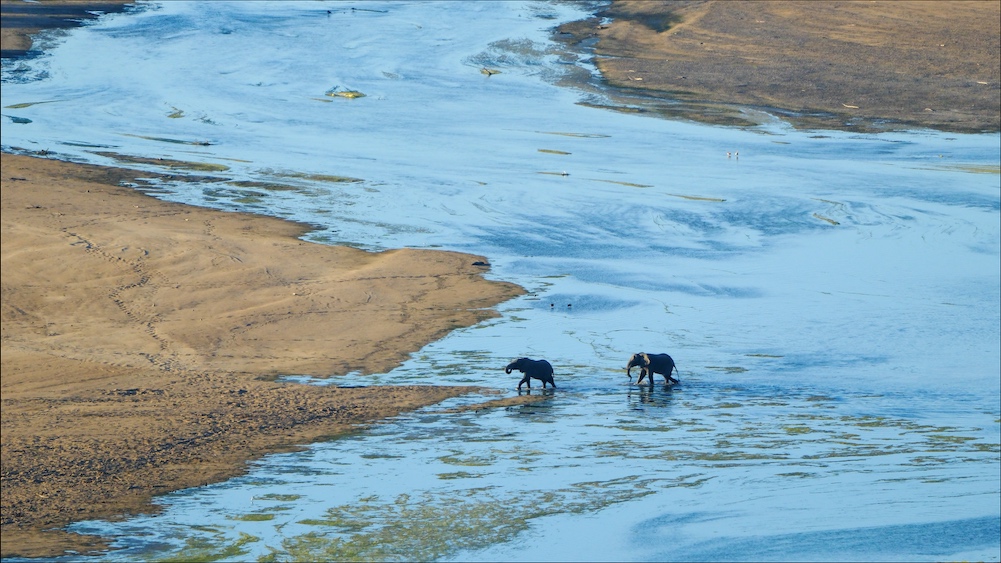 Elephants crossing the Runde
We stopped at a different Chilojo overlook on our big day of driving the park and had a great view of some antelope down in the valley and elephants crossing the Runde.
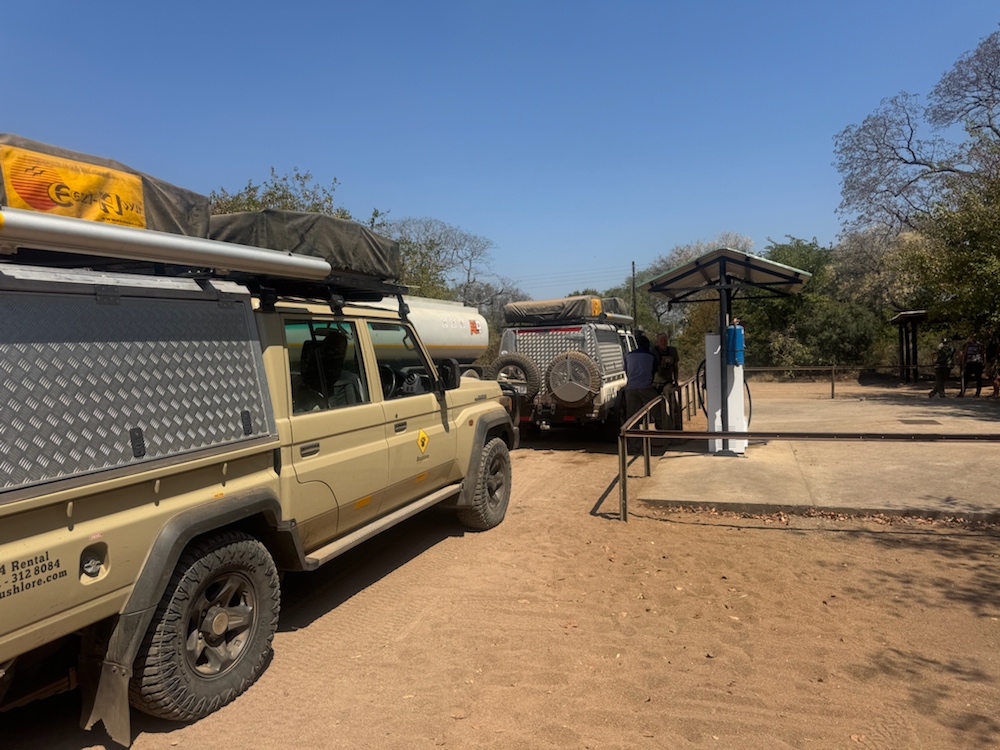 Refueling at Chipinda
You burn a ton of fuel navigating around this park and while we had 8 jerry cans of fuel available to us, we happily stopped at the staff fueling location near Chipinda to fuel up. This was near our final campsite at Chipinda Pools where hippos and shorebirds played in the river below us.
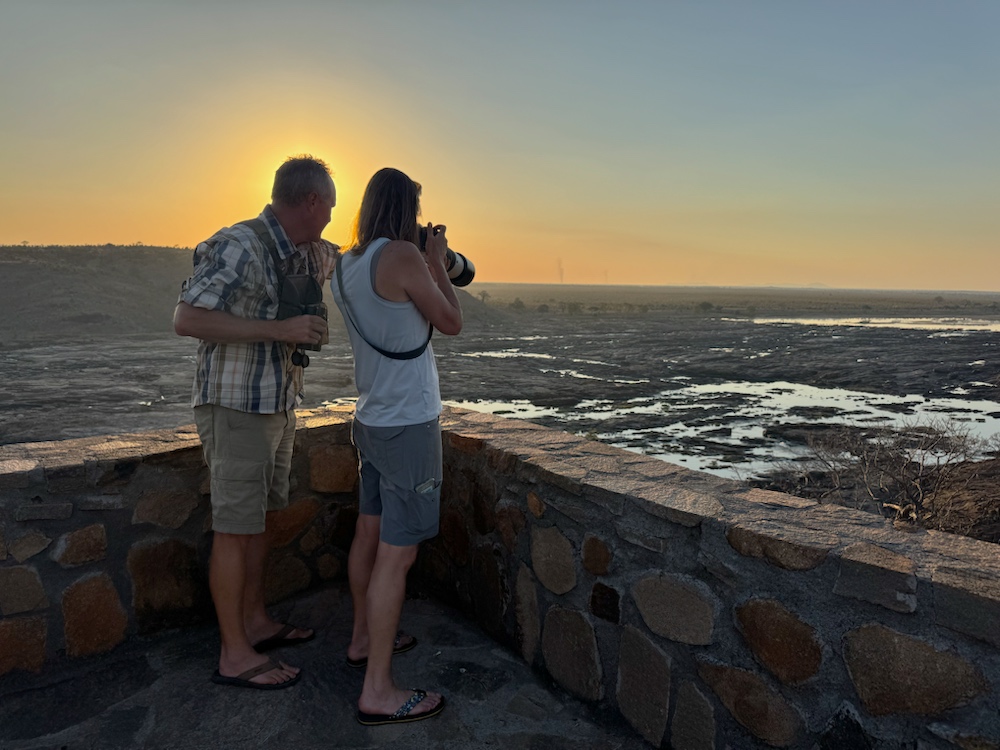 Scott and Karen look out over the falls
Our evening drive took us out to another pan then to Chivilila Falls, a shockingly beautiful and unexpected stop. We had been on the river just below and just above this area and couldn’t believe our eyes. Because of heavy rains and flooding earlier this year the river is running strong, and apparently earlier this year you couldn’t even make out most of the rocks in this falls area. A great place to spend our final sunset.
Back to the Abbey quote at the start of this post: this park reminded me of what he had envisioned and prayed for at Arches National Park. Make the park accessible but not too accessible. The payoff seems greater when the work to get there as harder. This is Gonarezhou today and I hope it stays this way.
One final note about the challenge of driving to and through Gonarezhou: we ran into a couple in the mall parking lot in Musina that have an overlanding trailer; a bigger one with two axles. They were part of a group of six overlanders with trailers, and every single one of them sustained permanent damage that will require repair. The couple we talked to had worse than that: a bent axle and completely ruined wheel that would subsequently require a tow back to Johannesburg. If I were headed into that park with a trailer I would only want to do so with a lighter single axle overlanding model.